The walk home from the gym can feel longer than the workout. After a hard session, a long run or a demanding match, feeling wrung out is a familiar experience for many gym-goers, athletes and marathoners. That moment also attracts a crowded shelf of recovery powders. Before choosing another scoop, leave some room to ask what the session demanded and what comes afterwards.
This guide is about ordinary post-exercise tiredness, not unexplained or medical fatigue. It is general education, not medical advice or a way to diagnose a condition. Our Daily energy guide looks at everyday daytime tiredness; here, the focus is the hours and days around training. Neither guide can assess individual symptoms or tell you which supplement you need.
Give the session some context
A first strength class, extra hill repeats or a longer weekend run may feel different from a familiar session. Weather, travel and a busy working week can also change the experience. Notice what was different without treating a training diary as a diagnostic tool. Being tired is not proof that a session was effective, and feeling exhausted is not a target to chase.
A brief note about the session, meals, sleep and how you felt later can make your routine easier to describe. Avoid turning each sensation into a score that must improve tomorrow. A coach can help discuss training demands; a qualified practitioner is the right person for health concerns. Neither role can be replaced by a product questionnaire.
Rest belongs in the plan
Training does not need to fill every available space. Rest days and easier days are part of a workable schedule, not an admission that you lack commitment. You do not have to earn an evening on the sofa with another session. If the week leaves no room to pause, consider the schedule before adding a product marketed as recovery support.
Sleep deserves the same practical attention as kit and race entries. Make room for a regular bedtime and a wind-down that fits your circumstances. Late caffeine from coffee, energy drinks or pre-workout products can complicate that intention. Read the total routine, not just the drink in your hand. A supplement is not a replacement for time available to sleep.
Food and fluid before a shopping list
After exercise, an ordinary meal or snack can be a useful starting point. Include carbohydrate foods and a source of protein that you enjoy and tolerate, rather than assuming recovery requires a special branded format. Rice with tofu, eggs or fish, for example, is food rather than a performance promise. Your needs depend on the activity and your circumstances, not someone else's social feed.
Keep fluid accessible and consider the conditions, duration and how much you have been sweating. More is not automatically better: do not force large amounts of water or treat electrolyte servings as a competition. Long events, hot conditions and individual health circumstances can require a more personal plan. A qualified sports dietitian or practitioner can help with questions beyond a general guide.
Read the recovery label slowly
Protein powders are optional convenience foods or supplements, not a requirement for belonging in a gym. Compare protein per serving, allergens, sweeteners, directions and price. Check whether the stated serving means one scoop or several. A familiar meal may suit you better. Buying a larger tub does not establish that you need more protein or that a product will change your results.
Electrolyte drinks vary in sodium, sugar and other ingredients. Magnesium appears in capsules, drinks and multi-ingredient blends; its presence does not establish that you need it or that it will resolve post-training tiredness. Check overlapping amounts across products, warnings and medicine considerations. Ask a qualified practitioner about suitability rather than guessing from soreness, a difficult run or an online symptom list.
Keep the promises separate from the purchase
Words such as “repair,” “recharge” and “bounce back” can make a label sound more certain than the information behind it. An ingredient's normal nutritional role is not a guarantee of faster recovery, better performance or fat loss from a finished product. Broad wellness powders, teas and stacks are not remedies for fatigue. A satisfying ritual and a medical effect are different propositions.
If you browse iHerb or Thorne, use the official information to inspect current labels, not to infer an endorsement from their appearance here. Competitive athletes should also consider their sport's supplement rules and independently check any claimed third-party testing. Certification has a defined scope; it is not a promise of benefit or zero risk. No purchase is needed to use this guide.
Know when shopping is the wrong next step
Persistent, unusual or severe fatigue, chest pain, fainting, or symptoms that worry you deserve attention from a qualified practitioner. Chest pain or fainting during or after exercise can require urgent medical care; do not push through or wait for a supplement to work. Familiarity with hard training does not make concerning symptoms something to dismiss. Leave room for rest, honest limits and appropriate help.
East meets West · the research
Research from Asia
Studies published in Japanese, Korean, Malaysian, Chinese and TCM journals, read with the same care as our other sources. Some were published in Japanese, Korean, Chinese or Malay; we show the original title and an English translation, and summarise them in plain English. We note small samples, animal studies and company-run trials. These summaries describe what was studied; they are not promises of results for you.
- Malaysia / SE Asia
Abidin NZ, Ooi CH, Nosaka K, et al. (2024). Effects of Resveratrol Supplementation on Delayed Onset Muscle Soreness and Muscle Recovery: A Systematic Review. Malaysian Journal of Medical Sciences (Malaysia).
In plain English: A systematic review from Universiti Sains Malaysia of 10 studies (238 people) on resveratrol after exercise; it may reduce some muscle-damage markers and soreness to varying degrees, but results varied with the type of exercise, dose and timing, and longer-term studies are lacking.
- Malaysia / SE Asia
Mohd Daud SM, Sukri NM, Johari MH, et al. (2023). Pure Juice Supplementation: Its Effect on Muscle Recovery and Sports Performance. Malaysian Journal of Medical Sciences (Malaysia).
In plain English: A review from Malaysia's National Defence University on polyphenol-rich fruit juices as a food-first option for muscle recovery and sports performance after hard exercise, summarizing an evidence base that is still developing.
- Korea
Lee NH, Jung HC, Lee S. (2016). Red Ginseng as an Ergogenic Aid: A Systematic Review of Clinical Trials. Journal of Exercise Nutrition & Biochemistry (Korea).
In plain English: A systematic review of 14 trials (searching English and Korean databases) on red ginseng and exercise; most found no improvement in aerobic or sprint performance, and results for recovery markers were mixed.
- Malaysia / SE Asia
Ahmad NS, Ooi FK, Saat Ismail M, et al. (2015). Effects of Post-Exercise Honey Drink Ingestion on Blood Glucose and Subsequent Running Performance in the Heat. Asian Journal of Sports Medicine (Iran) · research from Universiti Sains Malaysia.
In plain English: A small randomized crossover study of 10 runners in Penang; after a 60-minute run in 31°C heat, rehydrating with an acacia honey drink rather than plain water was followed by a longer distance in a second 20-minute run.
- Japan
小栗和雄, 館俊樹, 薮本保, 松岡敏男 (2015). 遅発性筋痛および筋機能低下に対するクルクミン投与の効果 [Effects of curcumin on delayed-onset muscle soreness and loss of muscle function]. 教育医学 (Journal of Education and Health Science) 60(4):206–215. Japan.
Japanese Published in Japanese with an English abstract; summary by Open Leaf. Author names are shown as published.
In plain English: Ten healthy men took 150 mg of curcumin or a placebo 30 minutes before a hard elbow-curl workout. After a three-month break, they swapped (a randomized, double-blind design). With curcumin, they reported less soreness and kept more strength and range of motion over the next four days. With ten people and one dose, this is an early result.
- Korea
Yoon SJ, Kim KH, Kim CJ, Park HC, Kang KH, Kim MJ, Kang SM, Kwak UH, Kim HJ (2008). 홍삼 섭취가 유.무산소성 운동수행능력과 중추 및 말초피로에 미치는 영향 [Effects of red ginseng intake on aerobic and anaerobic exercise performance and on central and peripheral fatigue]. 고려인삼학회지 (Journal of Ginseng Research) 32(3):210–219. South Korea.
Korean Published in Korean; summary translated by Open Leaf from the Korean abstract.
In plain English: Thirty men were split into three groups for 8 weeks: endurance training with red ginseng, training with a placebo, or red ginseng alone. Twenty-four finished. Aerobic fitness (VO2max) and blood amino-acid markers did not change significantly in any group. The authors saw small upward trends and suggest that ginseng plus training may help with tiredness, but read that cautiously because the main measures did not differ statistically.
- Korea
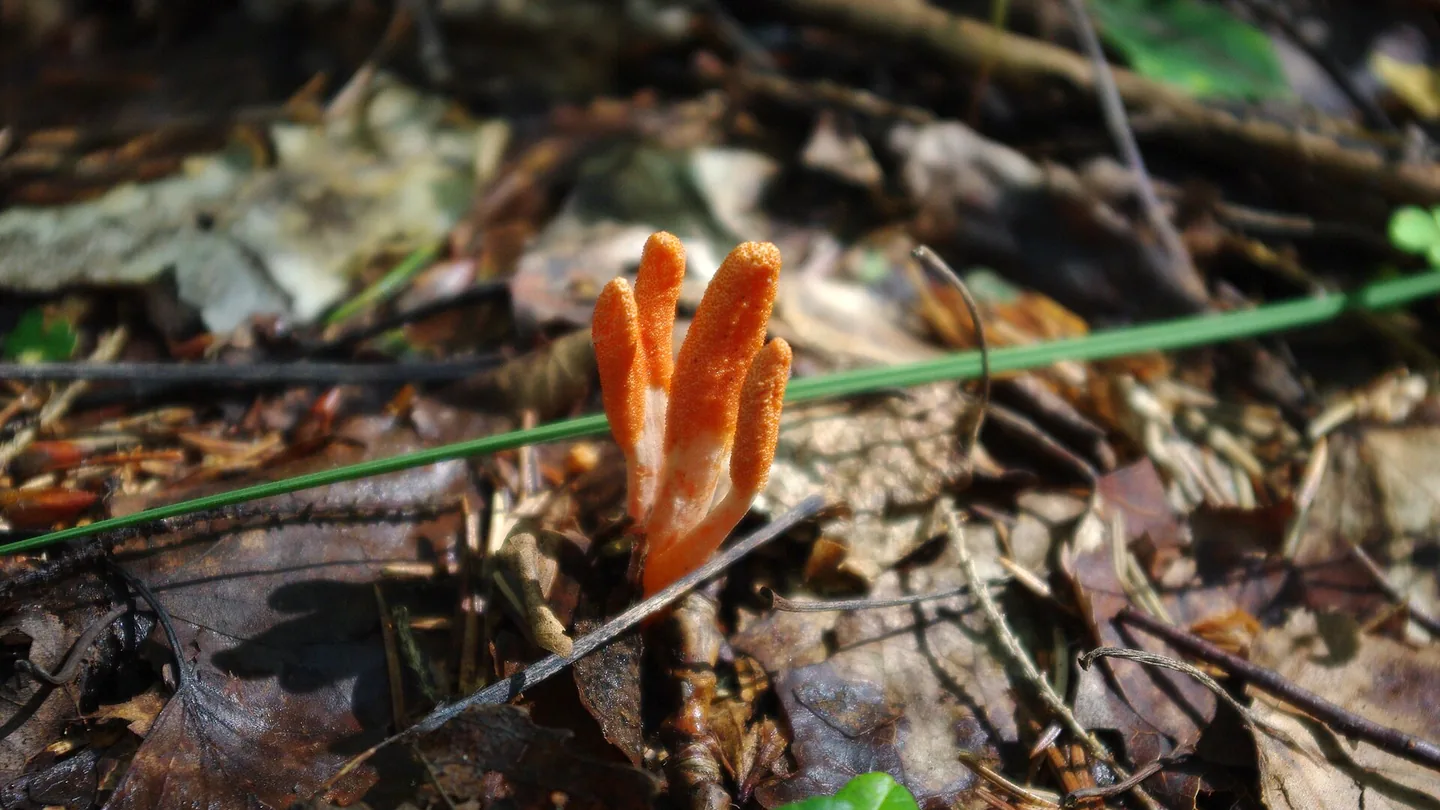
Paik IY, Han DS, Park TS, Kwak YS, Suh SH, Jin HE, Kim YI, Woo JH (2006). 목질진흙(상황)버섯과 동충하초 투여가 운동 시 혈중 피로요인 변화와 항산화체계에 미치는 영향 [Effects of sanghwang mushroom (Phellinus linteus) and Cordyceps militaris on blood fatigue markers and the antioxidant system during exercise]. 생명과학회지 (Journal of Life Science) 16(7):1090–1096. South Korea.
Korean Published in Korean; summary translated by Open Leaf from the Korean abstract.
In plain English: Fifteen male university students drank 100 ml a day of a sanghwang-mushroom drink, a Cordyceps militaris drink or a placebo for six weeks, with five students in each group. Exercise time did not differ between the groups. The mushroom groups showed somewhat lower fatigue-related blood markers and better antioxidant readings. With five people per group, this is a very early signal, not proof.
Each record was checked against PubMed, J-STAGE, KoreaScience or the DOI registry on 14–15 November 2026. Translations are Open Leaf’s own; please check the original for exact wording. Not medical advice.